


My online table recently wrapped a four-week story of Household, the tabletop roleplaying game about tiny people that live and fight and love in an abandoned Victorian house.
There is a lot of discourse these days urging players to move away from Dungeons & Dragons and play indie games instead. And there’s a lot of angst from these same folks because by and large it appears that players are not doing this. Unfortunately for them, I’m about to be part of the problem. After reading the book entire (twice!), reaching what I feel are the limits of what I can do with the setting, and discussing the dice system in-depth with my players… I can’t wait to get back to D&D.
The Book
The book is gorgeous, and filled with colorful, imaginative artwork — which is what sold me on the game in the first place. It even has one of those handy built-in bookmark ribbons that every fancy book should have. It looks handsome on the shelf, and that’s about ninety percent of a TTRPG book’s job, anyway. If you like collecting TTRPG books, Household might be worth picking up even if you never intend to play it.
The book is written from the perspective of an in-universe historian. This makes for a very pleasant read, and works in those chapters which are detailing the setting and storyline material. It works less well for those chapters detailing rules and mechanics. There are moments where the narrator’s voice brings the rules across unclearly, and that’s an issue for the “game” side of this roleplaying game.
The full title of the book is actually Household Volume I. Apparently Volume II is currently undergoing crowdfunding. I could see myself picking up a second book in this universe, providing it’s about the same quality as the first, if there weren’t another indie game in my eyeline that had piqued my fancy.
The Setting
Here’s the part of this post that’s going to make you want to play Household.
The setting is a large, opulent, somewhat dilapidated Victorian-era manor house. Inside the house are all the usual suspects: vermin, insects, creeping molds, what have you. In addition, the house is infested with littlings: tiny people who treat the house as their world, their prize, and their battlefield.
The game doesn’t give us a scale to work with here, and in fact explicitly tells us not to sweat the particulars. In some depictions, littlings are as tall as a human finger, wielding scissor blades as swords and covering ground on trained riding mice. In others, it describes littlings as taking weeks-long treks across desolate hallways in the looming shadows of shag carpeting. If you’re the kind of gamer who wants consistency in your fantasy realism, Household is going to make you pull your hair out. But if you’re willing to just let the whimsy carry you, it works really, really well.
There are four kinds of littlings. Boggarts are the workhorses who build things and bash things, and can grow up to twice their size to tackle big jobs. (Or big rodents.) Fairies are pompous flying creatures who see themselves as the ruling class. Sprites are mischievous and attuned to the house’s elemental nature: the drain, the draft, and the spark. And sluagh are creepy bug-people who live in the basement.
A typical Household adventure might take you to one of the fantastical littling cities, from the mechanical wonders of Clockminster to the flooded streets of Tuberdam. Or, it might take you into the insect-infested wilderness of peeling wallpaper and creaking floorboards in search of rare fungi stalks. Or it might take you into the terrifying in-betweens, those strange liminal spaces inside the walls and behind the furniture.
But you’re just as likely to become embroiled in court intrigue at a fairy gala, or into military negotiations between two regiments of boggart gendarmes, or striking magical contracts with legendary trickster spirits.
I set out to run four sessions of Household. I set the story in the city of Beddingham, the sprite capital city on the upper floor. My plan for each session was:
- Character creation, party introductions, and a series of riddles leading to an eccentric inventor who is being shaken down by gangsters.
- An excursion into the in-betweens to gather materials for the inventor, so he can build his “fantabulous clockenized menagerie”.
- The gala event of the season, where the Grand Beddingham Hotel leased out its ballroom for the clockenized menagerie’s priemere exhibition.
- The final encounter after everything at the gala goes wrong, and the players have to try and set things right again.
Each session was designed as a series of encounters, and the gala in particular was designed to have no combat.
The Dice System
Here’s where Household fell apart for us.
Up front I want to stress that my players and I like rules. Correctly understanding and accurately following rules is part of what makes games fun for us. We have software engineers and chemistry professors and RHEM players at our table — it’s in our blood. So while a simple dice system often translates to a better experience at some tables, that isn’t necessarily the case at ours.
But Household isn’t just a simple dice system, it’s a system with a clever twist. And in my experience, trying to put a clever twist into your game’s dice system almost always falls flat.
The game uses a d6-based system. Your rolls are determined by Attribute + Skill. A bad roll in a skill you aren’t good will be 2d6, and a good roll in your specialty will be 6d6. You can use standard d6s for this, but the numbers don’t actually matter — you’re looking for matching glyphs. Rolling two 2s is just as good as rolling two 6s. They sell special Household dice that use extended card suits instead of numbers, and that’s what I used too, inside of Tabletop Simulator.
Matching two-of-a-kind is a Basic Success. Matching three-of-a-kind is a Critical Success. Matching four-of-a-kind is an Extreme Success. And so on. The number of matches, and how big they are, determine how well your character succeeds and also what additional actions you might take.
After you roll, you can re-roll any dice that aren’t part of a success to try and improve your standing. You cannot re-roll any dice that are already part of a matching set, even if that matching set isn’t currently helping you. Consider the following roll:
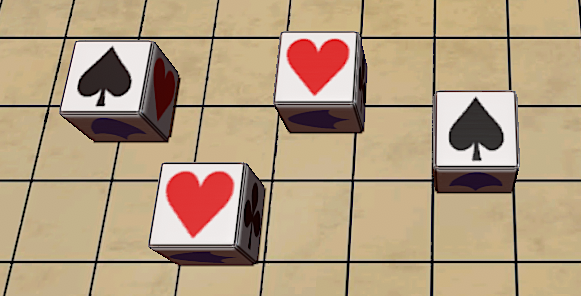
This is two Basic Successes. If that was your target, you’re fine. If your target was one Basic Success, you’re double fine — you can either use your extra success to take another action, or pass it off to an ally who needs it. But if your target was a Critical Success, you’re not only not fine, you can’t re-roll any of this. You’re just stuck. Those pages of clever re-roll mechanics don’t do anything for you.
The game tries to mitigate these dead-end cases by espousing “Fail Forward” and “Success at a Cost”, but a slightly mitigated failure is still a failure, and doesn’t feel good at the table. Sure, failure isn’t supposed to feel good, but in Household it feels a little worse than normal. When you arrive at a failure point, you’ve either rolled the dice multiple times and failed to improve your standing, or you landed in a case like I showed above, and your only recourse is shrug emoji. My players took both types of failure harder than if they’d just botched an attack roll in D&D.
Rolling also takes a lot of time. To properly adjudicate a combat round (or similar period of time) each player completes their rolls and re-rolls and needs to examine what other players have rolled. Because you can pass successes, and because partial successes mitigate failure, players are highly incentivized to hit the pause button after each block of actions to solve a little puzzle about the most efficient way to spend all the successes sitting on the table.
I can already hear people marching from the woodwork insisting we should not play the game that way, but remember: my players and I like rules. Solving these little puzzles was part of the experience for us, but it never felt like it was an experience the Household writers wanted us to have.
This is actually a common design flub I see whenever I dip my toes into the ocean of indie TTRPGs: by making their dice system “simple” and “fun”, they believe they’ve crafted a game that’s easy to learn but also interesting to engage with. And I think the spell probably does work on some tables. For us, though, it created a lot of decision points where we were pulled out of the immersion of the game to interact with the physical dice, instead. They weren’t an abstraction, they were part of the game.
These Attribute + Skill rolls comprise every roll in the game. There are Action Rolls when players do stuff, and Reaction Rolls for when NPCs do stuff to them, but functionally they’re the same thing. No matter what type of littling you play, what profession you choose, or how you decide to build your character, it’s always going to boil down to alternating throws of pools of d6s.
I like the simplicity a lot when running social or exploration challenges. A player states what they’re doing, I tell them what to roll, they roll it, we move on.
But combat simply didn’t work. There’s very little sense of littlings being in a particular position or doing a particular thing. All the players make Action Rolls against the toughest enemy, and then each enemy forces them to make a Reaction Roll. There’s little room for personal expression or clever tactics. All damage is abstracted down into a Stress meter, and whichever team is still standing when the other team’s Stress is depleted wins. Coming up with a clever move or tactic might change the type of roll you need to make, but doesn’t otherwise grant you any benefit.
So, the dice system was too simple to properly model everything the game wants to do, but also too clever to fade into the background of the game. If we’re going to be spending this much time fiddling with the dice, we really need better payoff than “throw another pool of d6s”.
The Stuff I Liked
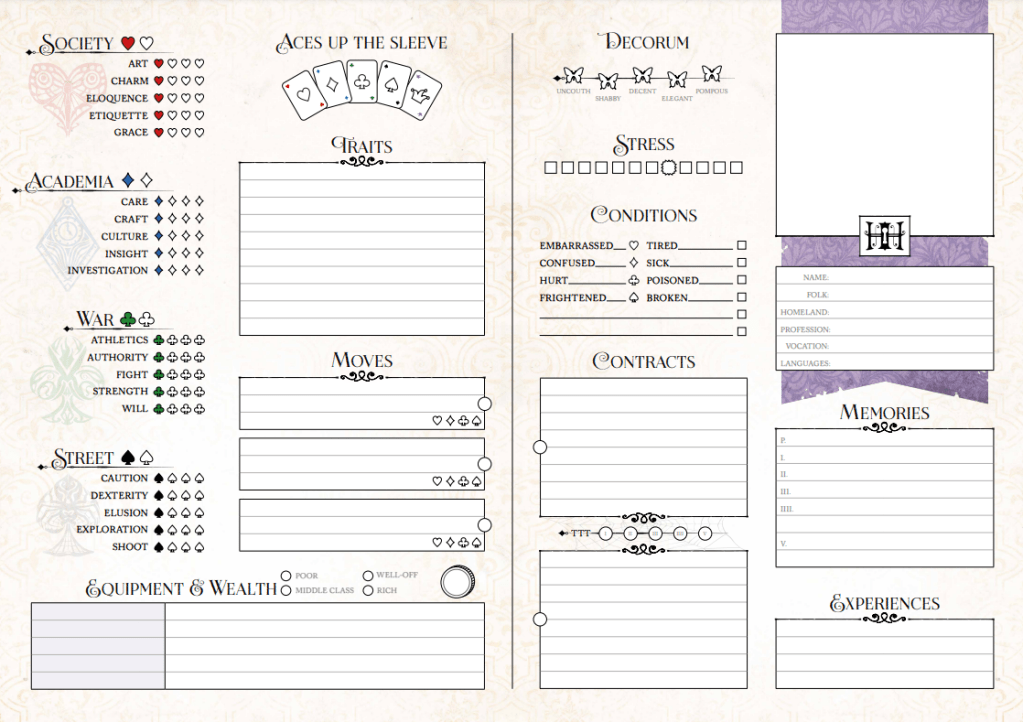
Household has a sort of “flavored Inspiration” which worked really well: Aces Up the Sleeve.
Your character can have up to five aces: one of each card suit, plus a Joker. The suits are associated with your four Attributes: Society, Academia, War, and Street.
(They are not, however, associated with the suits depicted on the dice. The book does state this outright, but I bet a lot of tables were confused about this.)
You can, at any time, spend an Ace to get a bonus die on an associated roll. An Ace of Clubs gives you an extra die on a War roll, for example. Or, you can spend it to recharge a special move with a club icon next to it. Or, after failing a roll, you can spend it to change your approach to a new action utilizing the associated Attribute.
That last one is a re-roll mechanic I haven’t seen before. Imagine you are trying to climb up a wall. That sounds like a War + Strength check. Your character sucks at that, and boy howdy, you botch the roll. But you have an Ace of Diamonds in your pocket. You say, “I’m cashing in my ace to change my approach to Street + Exploration. I’m familiar with this type of wall, and parkour up it instead of climbing.”
My players got the hang of using their Aces pretty quickly, and spending them did help mitigate some of the badtimes caused by the dice system.
The system for handing out Aces is a nebulous “give someone an Ace whenever they do anything cool”, which I’m never a fan of. If I were running a long-form Household game, I’d need to codify a system that doesn’t require subjective judgment calls. For this short series, though, I just let my players refresh the Aces in their two high Attributes at the start of each session.
The Metaplot
An element of Household which didn’t excite me, but which I imagine will be a draw for a lot of its playerbase, is the way its metaplot advances.
When the game begins, the house is experiencing a calm but tenuous peace. The four races of littlings exist in an uneasy symbiosis underneath the leadership of a Grand Council chaired by the leader of each nation. The de facto leader of this Council is the self-appointed High Empress of the Fairies, whose titles literally stretch on for half a page.
But the house experiences changes as time goes on, both physical and political. Each chapter of the players’ story is supposed to coincide with an ongoing metaplot where tensions rise and war looms once again. One example the book gives is certain types of black powder weapons aren’t available at the start of the game because they haven’t been invented yet.
I largely ignored this aspect of the game, and I think I would even if I were running a longer campaign. Taking a step outside myself, I see this kind of thing as being quality-neutral. For every table that uses the metaplot to provide a rich sense of background for the players to go adventuring in, there will be another where the DM uses it to browbeat the players into the published timeline.
For my part, I usually feel more constrained by metaplot than inspired by it. I’m much more comfortable with a homebrew setting, because I like worldbuilding and I like writing stories. This puts me into a weird position where I really like reading TTRPG books with rich setting material, and I’m perfectly happy to play in them… but running them feels like an extra set of chores to accomplish what I would have had an easier time just doing myself.
A Cool Place to Visit…
…but I don’t want to live in this house. My table will be going back to D&D for our next campaign.
Somewhere outside the scope of this review is a discussion about how many tables actually want a game like this as their base roleplaying experience. It was definitely a cool little game, and we definitely had fun with it for a few weeks, especially considering the vibrant and original setting. But I just can’t envision a table coming back to this dice system week after week.
 rjscibbe.com