

First of all, I get a chocolate-covered trophy for making it like five posts into my new blog before falling back on video game reviews.
Second of all, I miss rhythm games. Well, okay, I miss Rock Band. I miss cobbling together a fever dream setlist of Oasis, Phil Collins, and Gorillaz, then batting away the resulting colored squares with my plastic guitar. Truly, 2009 is a bygone era.
There are two aspects to making a rhythm game truly shine: you need excellent music, and you need excellent mechanics. Rift of the Necrodancer has both. If you’re in the mood for a rhythm game, that might be all you need by way of recommendation.
Crypt of the What Now
This whole business popped off in 2015 with Crypt of the Necrodancer. It was late to the roguelike renaissance we were all exhaustedly trudging through, and so it distinguished itself by making you play a rhythm game at the same time. Every move had to be on the beat, or you suffered penalties. The game boiled down to some simple rules which rewarded detailed game knowledge and quick decision-making. I thought the game was cute and invested a few runs into it, but I didn’t go tumbling down the rabbit hole like some of my homies did. I largely forgot about it.
In 2019 the same team put out Cadence of Hyrule, a cross-over game with The Legend of Zelda. How an indie developer with one feather in their cap strongarmed Nintendo into loaning them the keys to their flagship license is a tale lost to time. Nonetheless, the planets aligned and the game kicked ass. In my estimation Cadence had more staying power than the original Crypt; it was helped along by several years of roguelike recovery time, and all the Zelda stuff twanged my nostalgia chords. Each time I power on my Switch I briefly consider abandoning whatever game I was about to play for a quick Cadence run instead.
So when the Rift of the Necrodancer demo hit, and the gameplay looked like every other “notes a-comin’ down the lanes” rhythm game I’d ever played, I wondered whether the franchise was taking a step back by carving away the most interesting gameplay elements.
And then I put more hours into the Rift demo than I ever put into Crypt. I played those three songs until my poor fingers seized up with rictus and bled away down to their nubs.
Tap the Arrows, Forehead
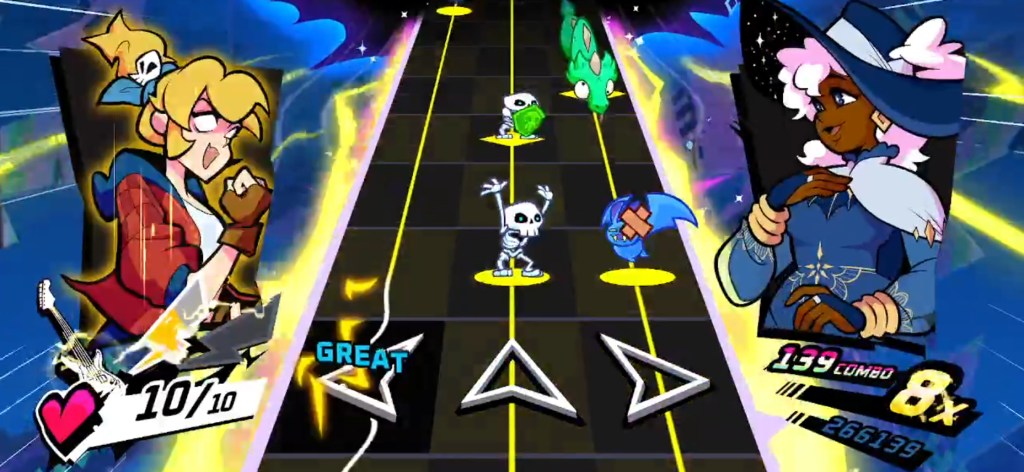
The mechanics are simple: notes bop relentlessly into the foreground, and you tap the left, right, or up arrows in time with the music to clear them. You’ve played a million rhythm games like this. The fact that there are only three lanes might lull you into thinking Rift is a novice entry to the genre.
But then you realize the notes aren’t just monster-shaped. They’re actual monsters.
They start you off with slimes, which have to be hit in time with the beat up to three times, depending on their color. Then they send in the skeletons, which retreat after you hit them once, assuming you broke through their shield with a double-time hit. Bats have to be chased down the direction they’re facing, harpies advance two beats along the chart instead of one. Then they stir in magic portals and off-beat notes and all kinds of other necro-musical chicanery.
I played the demo on keyboard, following the game’s recommendation. The game works great like this, but the bones in my hand were screaming for an ice bath after a couple of songs. When the full game hit I switched to my PS5 controller, where the d-pad and the face buttons count as equivalent input. Now that I’m playing the game with my thumbs the pain has subsided, but there are weird input issues I have to work around. Left and right can’t be pressed simultaneously on a d-pad, which is largely fine because your thumb doesn’t want to do that anyway. You can press as many face buttons as you want, but for some reason the game counts d-pad input as dropping your face button. This makes the sustain notes much trickier than probably was intended. I wonder if it’s a bug.
(Note: I just played a few songs to grab screenshots for this review, and the controller input seems to be fixed. Now I’m holding sustains just fine. That’ll teach me to draft a review before the inevitable day one patch, I guess!)

In addition to the standard rhythm levels, the game’s story mode also features boss fights and minigames.
The boss fights will remind you of Space Channel 5, and closely resemble the sort of thing you’d see when someone puts a rhythm section into some other game. Tap in time to the beat to dodge attacks, and try not to get distracted by all the pretty animations. The song loops until you deplete the boss’s health meter, so you have to demonstrate some skill in order to win. I would have preferred a fixed time fight, so the music could appropriately crescendo toward the end. But the boss songs do appear as standard rhythm levels after you defeat them, which accomplishes much the same thing.
The minigames would be right at home in Rhythm Heaven. You make burgers, snap sexy headshots, and strike yoga poses when the cartoon NPC tells you to. I found a few of these to be questionable, and I’m still not sure I understand how the one with the bird costumes is supposed to work. With some practice I could see these being a pretty zen experience, and I wouldn’t mind getting another pack of them as DLC at some point.
Rock Out With Your Warlock Out
Is the Necrodancer a warlock? I don’t know if that joke even makes sense.
The drawback to making a bespoke soundtrack for your rhythm game is, naturally, your players don’t know any of these songs yet. I always find that I bring my own silly baggage to a new rhythm game. Sightreading tracks in Rift is a much bigger ask than in, say, Theatrhythm: Final Bar Line, because even at power on, I already know how Battle at the Big Bridge goes.
It helps, then, that the whole Rift soundtrack is actual fire. Many of the tracks were composed by Danny Baranowsky, of Super Meat Boy and The Binding of Isaac fame. We’re in the neighborhood of spookily-flavored techno and electronica here, with strong percussion and hella guitar riffs. Lots of nice clear notes to match your keypresses to. That’s the benefit of making a bespoke soundtrack for your rhythm game: you can ensure none of your bangers falter at being video game levels. Battle at the Big Bridge is fun to listen to, but a nightmare to chart.
Among my favorite tracks are Alex Moukala’s Ravevenge, which was included as one of the demo songs and taught me to fear skeletons jumping into portals; Jules Conroy’s Overthinker, which could pass for a haunted house level in Sonic the Hedgehog; and Danny Baranowsky’s King’s Ruse, which takes an unexpected turn towards blues-y and throws more armadillos at you than should be legal. And then there’s like thirty more.
Of course, the game has modding tools so you can chart any track you want. Most of the fan-made levels I’ve sampled have been terrible, because even if a fan has the chops to make a good track, not every song they pick lends itself well to a playable format. But hey, give it a month and you’ll probably be able to necrodance to the SNL cowbell sketch and everything Perry Grip ever pooped out.

So, Probably Buy This I Guess
If you’re into rhythm games, I mean. If you’re not, there’s probably no hope for you. The game has pretty good difficulty settings and no-fail options, in case you like the genre but suck at playing. You’ll still get to experience all the game content and enjoy all the tracks, at least until the march of zombies drags you down to hell.
I do still wonder whether those guys who went deep into Curse of the Necrodancer will find what they’re looking for here. I happen to enjoy tapping along with lanes of marching notes, but players who love this team’s previous two games for their roguelike elements might feel Rift is a step back. Then again, maybe making a pair of quirky rhythm roguelikes gave the developers the energy they needed to make Rift of the Necrodancer the incredibly solid, classic-style rhythm game it ended up being.
Thanks very much for reading, and be sure to leave a smarmy comment when you snipe my 622k Hard Heph’s Mess.
 rjscibbe.com