


…but I suppose explaining it might be fun.
“Addiction” is probably too strong a word. I’m not freebasing catgirl erotica directly into my veins over here. But I have read enough this past year that my Audible recommendations look like this:
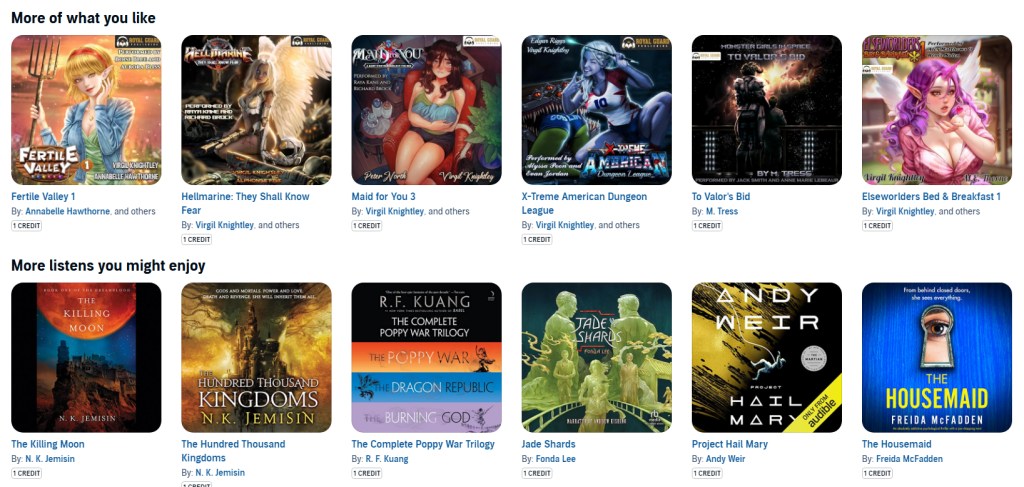
For what it’s worth, my two most recent reads are N. K. Jemisin’s The Stone Sky and Heather Fawcett’s Emily Wilde’s Compendium of Lost Tales, the third books in fantasy trilogies I think are absolutely outstanding. But they aren’t romance stories. They are stories which contain romance as an element — a major element, in the case of Emily Wilde — but the focus is on the adventures and catastrophes and battles and henceforth. They’re more in the ballpark of the fantasy novels I wanted to write.
When I turned the first revision of Faunel Tales over to my lady wife to read, she had many questions. Chief among them was why I had written a romance novel.
The question danced around my head for a while with no answer. I didn’t think I had written a romance novel. But then, I had never actually read one before. No basis for comparison. And so, my wife handed me her copy of Sarah J. Maas’s A Court of Thorns and Roses.
I came away from that book with two clear conclusions: Faunel Tales is definitely not a romance novel, and romance novels are not for me.
Meanwhile, some well-wishers on my Discord began cracking wise about how I had written erotica. This was good-natured ribbing, and deserved, since there is on-page nudity and sex. But again, I had never personally read any erotica. No basis for comparison. My wife insisted she didn’t have any for me to sample, and so I went onto Audible and found some on my own. I ran the experiment and decided that Faunel Tales is also definitely not erotica.
None of this was helpful in determining which sub-genre of fantasy Faunel Tales slots into, nor did it do any good in my never-ending search for comp titles. But it did give me a useful framework for categorizing fantasy romance that I didn’t have before.
To the best of my understanding, it works like this:
A fantasy novel contains a story in a fantasy setting. Lord of the Rings is fantasy because it has elves and orcs and stuff, and it’s about people going on adventures across wood and glen. The driving conflict is the big monster at the end, or whatever similar stand-in.
A romance novel contains a story about people being in love. The driving conflict is the relationship itself, or some element connected to it. Do these people know they want to be together? Are they going to bump uglies? Does the bumping of uglies cause further conflicts? Gone With the Wind is romance because, while there is literal military conflict amidst the backdrop, the actual emotional stakes are sewn up in the personal relationships of the characters.
A romantasy novel is a romance novel in a fantasy setting. A Court of Thorns and Roses is romantasy because while most of the action takes place in fairy land, the conflict and stakes emerge directly from the love triangle and the maze of gaslighting and dubious consent the heroine finds herself in.
An erotica novel is any combination of the above where every scene either acts to explore an explicitly sexual situation, or works as connective tissue to set one up. A Tale of Tail-Brushing is erotica because it alternates between scenes where the protagonists are having sex and scenes where you’re wondering when the sex is going to happen.
Okay, I’ve double- and triple-checked my notes, and I think I have all that right. Let’s move on.
Genre romance and erotica are both power fantasies.
This may be blindingly obvious to you, but as someone new to the genre, it wasn’t an angle I’d considered before.
The power fantasy in something like Thorns and Roses is exploring a romantic relationship with an otherworldly power imbalance. The heroine is a normal human everygirl, and the men swooning after her are essentially gods. If she does or says the wrong thing, or if she makes the wrong choice, she risks being blinked out of existence. I was surprised by how explicit this was made when the book detailed her sexual relationships. Consent was unclear. The heroine experiences memory gaps, extreme duress, and blatantly unfair ultimatums.
“Agree to be my sex slave, or I’ll leave you to bleed out and die on the floor of this cell.” Is this titillating? I didn’t think so, but can millions of women readers be wrong?
Moving over to the men’s erotica I sampled, I was surprised to find the power fantasies weren’t what I was expecting. Which is to say, I suppose, rape fantasies. Or, at least, the flip-side of the dubious consent that romantasy loves to play with. I’m sure those books exist — probably in much greater quantity than I could sleep comfortably knowing about — but they weren’t surfacing in the sampling of my Amazon recs.
The most common theme these stories seem to explore is protectiveness. The protagonists are burly heroic types: firefighters, knights, level sixty elemental warlocks, what-have-you. The essential formula is to establish that the gold-hearted hero is bored with the frivolous sex he is definitely having with any number of shallow but willing floozies, and that he craves something more. Something like… the hapless catgirl on the run from the mob. Or the kitsune with smoldering eyes and an orphanage in dire need of renovation.
Obviously, there are still problems with this formula. There’s an element of infantalisation going on, in order to properly explore the power fantasy of having a partner who is unable to function without the hero’s strength and prowess. The monstergirl fiction has the added spice of a non-human character experiencing animalistic urges — a strong biological imperitive to mate, and to do it with this particular man, on whom she is now imprinted for life. Physiologically-enforced domestic gender roles and built-in anti-cheating device, to boot.
Unless the monstergirl is a succubus, of course. Then you can basically forget about any “good girl” fantasies. The best you can do is hope the stiletto heels aren’t made from actual stilettos.
So is this just all good clean fun?
I don’t know. It’s just some musings after a couple years of reading outside of my comfort zone, half-justified as “market research”. But it did catch me off guard how one set of tropes iced me down so much, while the other set piqued my interest. Why yes, it would improve my romantic prospects if my new maybe-girlfriend was on the run from the mob. (And also had cat ears.)
None of this exploration has done much to influence Faunel Tales. My outline was complete and the first fifteen chapters drafted before I embarked on this long, weird road. I’ve made the conscious choice for consent in my own work to be crystal-clear, and if there’s any infantalisation going on, it’s flowing the other direction. But it’s been enlightening to see what else is on offer.
Just don’t ask me about LitRPG yet. I’m still… trying to wrap my head around all that.
 rjscibbe.com