


Blue Prince is my game of the year for 2025. I typed that sentence with full confidence, even though it’s only mid-August, and even though I have pointedly skipped just about every major release I was looking forward to this year. It really is that good. It may well be my game of next year, too.
But I didn’t finish it. I know that I’m at the end, I know what’s left to do. I’ve even been able to quantify how much game I have left, in terms of applied hours. But… I haven’t. And probably won’t. I don’t want to. And not in a cutesy, heartsick, “I don’t want it to end!” kind of way. More in a, “I should not have eaten seven slices of chocolate cake, please call an ambulance” kind of way.
This is a story in four acts. If you’re spoiler-sensitive, you’re good to read this bloggity-post through Act I. I’ll give you another spoiler warning before going into Act II.
Act I: The House
You’ve heard Blue Prince called a “roguelite house-builder”. That’s exactly what it is. On Day One you’ll step up to the house, and be presented with three doors. Opening one gives you your choice of three possible rooms on the other side. You select one, the door opens, and voila! — you have a new room. This process is called “drafting.”
You run around for a while, drafting new rooms in all directions, until the game suddenly ends. Aha, each morning you’re given a finite number of steps, and walking between rooms consumes one step. In addition, some rooms are locked, and require a key. Others are more expensive, requiring gems to draft. Steps, keys, and gems: your resources to manage, ladies and gentlemen.
The house has 45 plots for potential rooms, arranged in a 9×5 grid. Your starting room is in the far south — rank one. Your destination is all the way in the north — rank nine. And so now you have a goal: plot a course from south to north, drafting rooms that advance your rank in the house and reward you with more resources for your run.
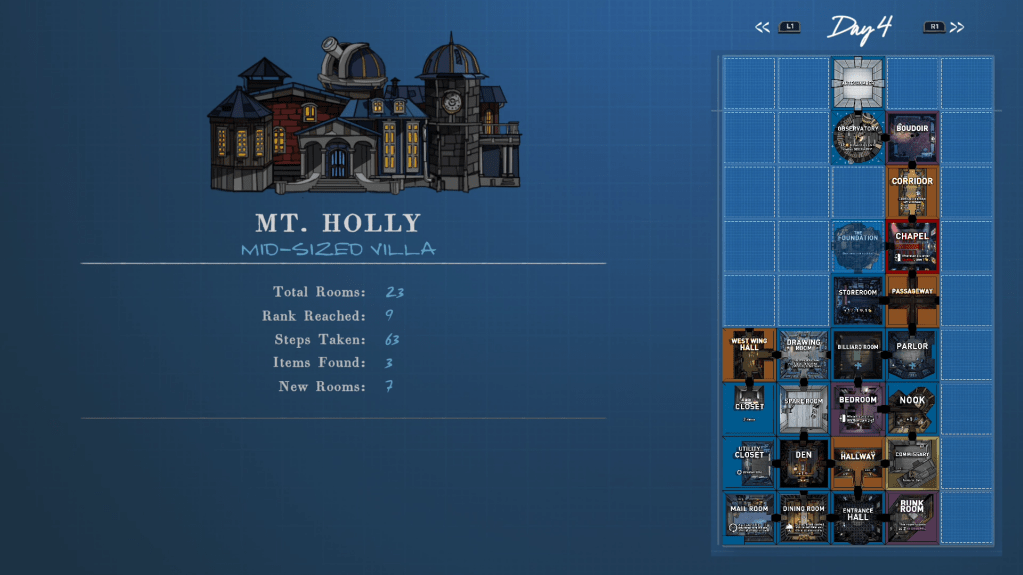
Each room has its own unique properties. Number and placement of exits, for example, or potential spawning locations for resources. Many rooms have interactions inside of them. Here’s three boxes and a logic puzzle. Here’s a map of the house’s piping system. Here’s thirty lockers requiring thirty keys.
As with any roguelite, you gain knowledge as you play. You learn what rooms are worth drafting early, to best scavenge for resources. You learn not to leave gaps in your house, and not to dead-end your northward progress. You start picking up inventory items, learn what they do, and where they’re likely to spawn. And, as ever, you draft new rooms. You’ll reach a decision point where you have a room you’ve never seen before, but you know that drafting it will end your current run. And no matter what you choose in that moment, you’ll get the niggling suspicion early in your next run that you chose poorly.
Eventually you’ll have a good enough handle on the mechanics to draft yourself a path to your goal… only to find a locked door, a new key that doesn’t open it, and a cryptic message that is more light encouragement than an actual clue.
But you’ve found other things in your exploration of the house, haven’t you? Messages and artwork, leftover notes from mansion staff, strange designs and colors. Machines that don’t do anything, safes that don’t open. And, by now, you’re good enough that reaching the goal room is something you can do every time. So the nature of your exploration shifts, and you start putting things together.
Eventually, you find a new path. You’re somewhere you haven’t been before, somewhere the rules are different. Somewhere your new key fits. The scope of the game increases, and before long, you find yourself back in the goal room, with the true hidden goal in sight. You step in, you see the ending. You feel satisfied.
But… not all the way satisfied.
Act II: The Keys
If that’s all Blue Prince was — just a roguelite house-builder where you spend ten or twelve hours figuring stuff out, honing your skills, and learning the inventory — it’d be a great $20 game that’s worth your time and investment. But there’s so much left to go. After this point, the game barely even feels like a roguelite anymore.
Here’s where the spoilers begin.

On your way to what you thought was the true, hidden goal, you passed through a spacious gallery with eight locked doors. You may or may not have dangling clue threads to follow at this point. It may occur to you to try again to reach the goal room. When you do, you find a new kind of key, and a shopping list hinting at where the remaining seven might be. You excitedly rush back to the spacious gallery. It doesn’t matter which door you unlock; you find yourself in another large room with a mysterious mechanism covered in bizarre markings.
Welcome to Act II. Hunt down the other seven keys, and make enough observations in the house to understand how these mechanisms work, and what they depict.
This will take you a very, very long time. You will scour and re-scour old rooms, and you will constantly find new things in rooms you thought were long finished. Your map of correlations will grow and grow. Information will blossom everywhere, in every corner of your environment. You’ll find new paths to old places, ask yourself why these paths exist, and in answering that question you will deepen your understanding and sense of place.
And the pieces you’re correlating? Oh, that’s the game’s story. You build it yourself, morsel by morsel. On one page of your overstuffed spreadsheet you keep a careful map of the family tree, and a list of characters whose placement you don’t yet understand. On another, you have a hastily-scrawled map of the country where the mansion sits, and a clunky pile of bits and bobs about the country’s history, geography, and government. And you just know, in your heart of hearts, that it’s all relevant.
You stumble across a literal classroom, absolutely filled to bursting with new information, and you salivate.
You learn more and more about your family, their religion, their politics, and every new thing you learn gets you one inch further into a room you didn’t yet fully understand. You find the second key. Then the third. Then the eighth. And you put all your amassed knowledge together, forming the story of this place and these people and this world.
Then the game asks, do you know how this goes? And you answer confidently, yes, yes I do. And you’re right. Another safe opens, revealing what can only be the for real this time true hidden goal. You feel satisfied.
But… still… not all the way satisfied.
Act III: The Poem
If that’s all that Blue Prince was — a competent roguelite which also contains a deep and engrossing narrative adventure game — it would be one of the all time greats. It would sit up there with Riven and Outer Wilds, a timeless beacon in the puzzle gaming landscape. A once-in-a-lifetime experience. That’s where the review ends, if the safe contains a resolution.
The safe doesn’t contain a resolution. It contains more clues. Only now, there’s nowhere left to go. Your boundaries are clearly drawn. You know this house and its surrounding environment better than any other virtual environment you’ve explored. What could be left to do?
Act I was about exploring the mechanics, and Act II was about solving the puzzles. In Act III, you start in on the meta-puzzles.
You have to really dig in, now. The gloves are off and the game is done helping you. And isn’t that a daunting thought? Because it didn’t feel like the game was helping you. It felt like you were fighting tooth and nail for every scrap of progress. It’s only now, looking back, that you see how carefully you were being led.
You will have to be systematic. You will have to re-re-scour everything all over again. You’ll find some clues read differently backwards from forwards. You’ll find machines that do different things, when you use them in different ways. You’ll take your blinders off. You won’t take anything for granted.
And you’ll fail. You no longer have a goal, except for the abstract concept of following each bit of information to the end of its logical thread. You don’t know what you’re looking for, or what you’ll find. But you do keep finding things. You do keep thinking of new things to try.
And then, you’ll try something that leads you to the poem.
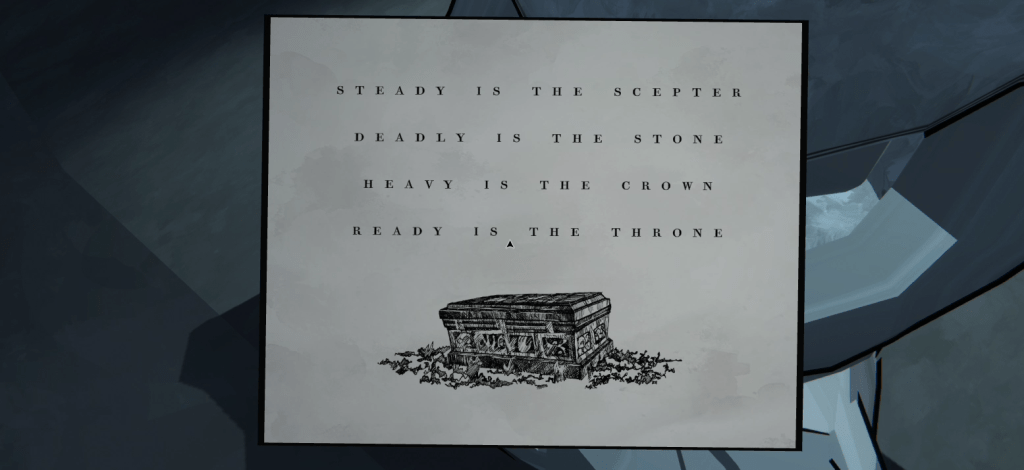
You’ll experience a moment of hyper-euphoria combined with crushing despair. You have a goal again. You know what this means. You know what to do with this. But you don’t know how to get there. Heck, you don’t even know where the pieces are. Hmm, no, that’s not quite right. You do know where one is, and you think you have a solid lead on another.
You get back to slowly, carefully, unraveling this place, layer by layer. You will make guesses, and be wrong. You will memorize the poem. You’ll speak it to yourself in the shower. The game won’t leave you alone, even when you aren’t playing it.
And through it all, the game will utterly and implacably refuse to help. Gone are the drip-feed of little successes from the first two acts. You’re not here anymore because there are bells and whistles to find. You’re here because you’re in too deep. Because you can’t not see it through.
You’re here because you have never played a game like this before.
Finally, you’ll have everything you need in place to do what the poem says. Your heart will be pounding as you take your final few steps. And the cinematic you earn as your reward… wow. It’s hard to remember a cinematic that has affected me as deeply. It’s something beyond special. It’s earned. And oh my goodness gracious is it satisfying.
But not… all the way satisfying, is it?
Act IV: The Core
The cinematic gives you one more task to complete, and not even a particularly challenging one. It feels less like a new puzzle thread, and more like a victory lap. You complete it, and open your first new room in many, many hours. And the game asks you, are you done?
If you say yes, you get one last little morsel to chew on. It’s not a new clue, or even a new A New Clue, it’s just a brief toast to your achievement. The game acknowledges you, and lets you go.
If you say no… you get nothing. An empty box.
But there are still clues in your notes you haven’t used, and threads that have resisted tugging on. Some of these lead you in spirals, some lead to tantalizing dead-ends. One or two feel like they should bring you somewhere new, except…
Well, in Act I the pieces you were playing with were your physical space: the literal rooms of the house, and the objects inside of them. In Act II you were playing with the pieces of the story, and arranging them together so both the narrative and the game’s puzzles made sense to you. And in Act III you were poking hard at the themes, the meta-narrative, the layers of puzzles overtop the puzzles. And these are all meaningful interactions, which brought you to one, two, three satisfying conclusions.
You break through a bottleneck, which leads to a bottleneck, which leads to a bottleneck. You find a slip of paper with 25 coded words, and a second with a mathematical formula. You ask yourself, am I really going to reduce this formula 25 times? And you answer yourself, of course you are, because it’s what’s left to do.
You find the still water. You find a blue door. You find a new space.

And… it’s the endgame. But what good is an endgame to you? You mastered the mechanics, solved the puzzles, processed the story, digested the themes. You are the blue prince. What’s left to challenge you, and what victory could justify the challenge?
Once you take away the space, the story, and the theming, all that leaves is the connective tissue. The puzzle constructs themselves. The busywork. That’s what’s left. A huge space filled with busywork. Puzzle after hand-crafted puzzle. The old solutions you were so proud of are re-applied in a new way, but without the sense of discovery, it all reduces to empty note-taking. The logic games you were so excited to solve previously, for the rewards they provided, now have nothing to offer you. Even the physical space you’re now moving through is a bland, featureless simulacrum of the lonely and beautiful mansion you’ve taken for your own.
Everything feels sideshifted and wrong. And, if you complete it, there’s nothing left. You don’t get another life-affirming cinematic, you don’t get another key piece of story that pulls everything else into perspective. You just… do it until you’re done.
I realized, as I moved through that space, that I was applying my brain cycles as elbow grease. I should have stopped hours ago, when the game was kind enough to ask if I was done. I was done. I knew it then. Going beyond that point could only be unhealthy, and so, the game doesn’t offer any more nutrition.
And so, once about three-quarters of the gristle had been chewed through, I realized that I hadn’t booted up Blue Prince in a few days, and had no desire to. But… I wasn’t satisfied. It’s never satisfying, leaving a game like that. I wrinkled up my nose. I blamed myself for not walking away when I should have, but I also blame the game, too, for egging me on.
Blue Prince is my game of the year for 2025. I will always remember it fondly, and I will revisit it from time to time, to spend another dozen days in my mansion. But I doubt I will ever finish it, and I’ll always have an unsatisfied sliver where the game should have ended.

 rjscibbe.com