


Like all prior editions, Dungeons & Dragons 5th Edition thinks you should award experience points (XP) for roleplaying and exploration goals. However, outside of lines like “award 3200 XP when the players find the frog gem” in published adventures, there’s no real guidance for how much XP “good” roleplaying or exploration is worth, or even what “good” means in this context.
Similarly, D&D 5e introduced the Inspiration mechanic, to provide players re-roll tokens as rewards for playing well. But again, only vague guidance for when Inspiration should be awarded, or how often. Many tables settle on something like “get Inspiration if you start the session and don’t already have it”, which does seem to defeat the point of the thing.
And so I invented blips, which solves both problems.
What are Blips?
A blip is an abstract game token. They aren’t in-world items that characters possess, and they don’t represent in-universe concepts, the way hit points or armor class do. A player can have between zero and six blips.
During a session, a player can spend blips to gain or force re-rolls:
- 2 blips to re-roll an attack roll, ability check, or saving throw,
- 4 blips for an automatic success on an attack roll, ability check, or saving throw,
- 6 blips to give an ally an automatic success on an attack roll, ability check, or saving throw,
- 6 blips to force an opponent to fail an attack roll, ability check, or saving throw*, or
- 6 blips (split amongst multiple players) to allow an ally to ignore a failed death save.
In addition, I sometimes use blips as currency for special mechanics. For example, in Flumph of the Wild players spent blips to cast spells they made with that campaign’s homebrew spellcrafting system. In Pirates of Flumph Water blips were used as charges for the party’s magical artifacts.
*Or, as is often the case, burn a Legendary Resistance.
Earning Blips
Blips are earned through roleplaying and achieving exploration goals. But here’s the really brilliant bit: the DM doesn’t award blips at all — the players do!
Each player can make their case to earn one blip for properly roleplaying their Alignment, Ideal, and Flaw over the course of the session. “My ranger is chaotic good, so I deserve a blip for freeing those captive sables from the furrier’s traps.”
My rule of thumb is to give each player their first roleplaying blip essentially for free, but then offer a little pushback on the second and third. As long as I can tell they’re playing in good faith, and they’ve put at least a little thought into their case, I’m happy to drop three blips on each player each session.
Then, there are four communal blips up for grabs, based on these questions:
- Which player had the most creative solution to a problem?
- Which player did the most to further the party’s goals?
- Which player had the most badass moment?
- Who else deserves a blip for any reason?
Players are incentivized to discuss the awesome things their allies did each session. They decide who was most creative, who was most helpful, and who did the single most kickass thing. And then they chalk up all the nebulous vagaries that come from a day of adventure, and award a blip for that, too.
Finally, I will award one blip to the entire party if I think they did an outstanding job on a non-combat encounter. Often this means avoiding combat when murderhobo would have been an easy but lazy solution. These are always a reward for good teamwork; no player ever earns a “bonus blip” from me.
This is of course entirely customizable. I don’t use Bonds at my table. Maybe you don’t use Alignment. For a while I even had Twitch chat voting to give out a blip each session. I’ve experimented with these rules a lot over the years, and you can too.
Blips as XP
If you’re just looking for a way to juice up Inspiration, or if you use milestone leveling, that’s probably all you need. But if you also want a way to codify XP gains for non-combat encounters in a way that scales meaningfully, keep reading.
Players can, at the end of a session, cash in any amount of blips to gain XP. Any blips a player gains after their sixth automatically rolls over into XP. The exchange rate is as follows:
1 blip = 1/30 of the XP needed by the highest level character to reach their next level.
That is, to level up without any combat, a player would need to cash in thirty blips, no matter what level they are trying to reach. Don’t worry, I’ve already done all the math for you. Here’s a handy chart:
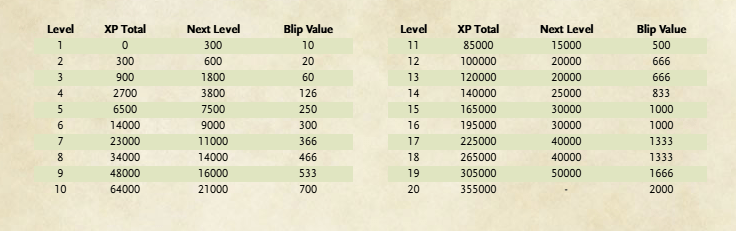
(Yes, required XP actually goes down for a while after Level 10. Nobody knows why.)
Find the highest character’s level on this chart, and everyone’s blips are worth that much. This means that a player who hoards all their blips to convert to XP in order to level up “early” also increases the value of blips for everyone else, making it easier for them to catch up. Except for Level 11.
If you like how Inspiration works already, and you just want an easy way to reward players for roleplaying and exploration, use this table and ignore all the stuff about re-rolls.
Does This Actually Work?
I’ve been using blips in some form for nearly ten years, and they’ve always been a hit with my players. They actually want to pay attention to each other and the cool things they do. They have some wiggle room during sessions if they absolutely need a clutch re-roll. They burn blips to speedrun Level 5 for Extra Attack and fireball. And they get an opportunity to pass out kudos every session, and see real mechanical benefit for the roleplaying side of the game.
As far as I know, D&D 2024 uses the same XP chart as 5e, so this should all plug in perfectly fine. Older editions and Pathfinder might need some jiggering on the numbers.
Go forth and blip with my good blessing, and thanks very much for reading!

 rjscibbe.com