


I have a very messy directory on my laptop that acts as a bucket for all my unused D&D ideas.
No, you can’t look in it. For your own safety.
It’s no secret how ideas tend to accumulate there. I do a lot of prep work for my D&D table, mostly by way of encounter design, and not every aspect of every encounter will make it into a live session. But an unused idea isn’t necessarily a bad idea, and it’s very useful to have an old bucket to go sifting through sometimes. An unstruck match can make fire later.
The third Flumph campaign, Flumph of the Wild, was set in a violent wilderness beyond the walls of polite civilization. For this campaign I limited players to only monster races — orcs, goblins, gross snake-people, what-have-you — and imposed a hard restriction on class selection. If a class or subclass had the Spellcasting or Pact Magic feature, it was banned. Martial classes only.
The reason I did this was to tell a story about a realm being torn asunder by different forms of powerful magics. The world decided it’d had enough of that, and pegged some up-and-coming monsterfolk heroes with its own brand of “World Magic” in order to combat the “Dragon Magic” and “God Magic” and “Dumb Fey Magic” that was running rampant. Instead of having spellcasting classes like wizard and cleric, players of any class had access to any spell they wanted.
The hitch is that I was planning to introduce this spellcraft system a few adventures into the game. My players would have to go through a few experience levels with no magical healing. Low-level D&D math being what it is, I wasn’t sure that was viable. Enter the dreaded DMPC.
The DMPC
DMPC stands for “Dungeon Master’s Player Character”, and it’s one of the most maligned concepts in tabletop gaming.
DMs often want to play in their own games, and will invent a character to go adventuring with the players. With a DM-controlled character on the players’ side of the table, it’s pretty easy to start hanging plot hooks on them, making them instrumental to the campaign’s story. Once that happens, the DM has a mouthpiece in the players’ party to offer in-character ideas and plans. And if you go far enough with this, you end up with a DM playing every aspect of the game in front of a bunch of bored players.
The flip side of the argument is, a DMPC is a decent way to plug up holes in an adventuring party’s composition. My thinking was, I could introduce a low-level healer who also acted as a mentor for the spellcrafting system they were about to fall into. Once the PCs were more established and had some spells of their own, I could retire the DMPC into a background role.
I made her a neutral satyr druid. Neutral, because she was investigating the awakening magics that were upsetting balance in the wilds. Satyr, because it’s a recognizable monster race that wasn’t available to the players. (The book introducing satyr characters hadn’t been published yet.) Druid, because cure wounds, and also see above re: balance in the wilds.
And then I saddled her with a bizarre fey curse, as a way to solve the DMPC issue.
The Curse
While I wanted a low-level healer to help keep the party upright, I didn’t actually want her overshadowing anyone in combat, which is something druids tend to do by transforming into bears. Also, I didn’t want her interacting with other NPCs. Any time I have to roleplay with myself at the table, I feel like a jackass with plugs crammed into the wrong sockets. Here’s what I came up with:
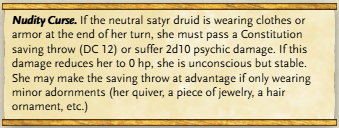
A permanently-naked character solved three problems at once:
- Feywild bullshit was planned to be a major element of the campaign’s story, so breaking a silly fey curse made for a good low-level adventure goal.
- Being naked is obviously undesirable, but outside of armor class doesn’t impose any mechanical drawbacks. The druid would be able to contribute to combat and exploration challenges, but she wouldn’t be at the front line where she risked upstaging the all-martial party.
- Being naked in villages or other social settings is extremely undesirable, so the druid would use her wild shape ability and transform into a small animal to avoid embarrassment. NPCs would mostly ignore her.
I had a healer character who was available for adventures, but wouldn’t impact the roleplaying in social encounters, and who had an easy exit once her low-stakes curse was dealt with. Maybe later in the campaign, she could return as a higher-level ally returning a favor.
Then What Happened?
Session zero happened, and character creation.
One player rolled up a whimsical bird-monk, and another rolled up a dragonborn channeling Andy from Parks & Rec. Those characters, I would say, fit pretty well into a whimsical party with the DMPC I had in my pocket.
But then another player rolled up a snake-man poisoner, and a fourth rolled up a humorless military captain. Now we’re maybe fifty-fifty in terms of tone.
The fifth player was new to the table, and an unknown quantity.
There was still a place for my nudist druid, mechanically speaking, but when the vibes seemed like they might go the other direction, I erred on the side of caution and swept her into my unused ideas bucket. There she stayed for the next five years.
(Not having a healer turned out to be perfectly okay. D&D 5e is a robust enough engine to handle any party composition — but that’s a lesson I hadn’t learned yet.)
Brain Problems
Meanwhile, I’d been trying to get a novel off the ground since 1999.
There’s lots of reasons these projects always failed: lack of discipline, frustration with research, crippling impostor syndrome. A typical failed novel petered out after a few thousand words, at which point my brain would junk the idea. While I have a bucket for unused ideas, I don’t have one for failed ideas. Once I’ve taken a swing at a concept, I feel like I’ve reached the limit of what that idea can do for me, and I discard it. It’s no use trying to revisit later with a clearer vision or better framework. My brain simply won’t let me.
It’s really too bad. I’ve thrown away a few good ones over the years. Maybe I’ll share them on this blog someday, and you can do something with them.
Anyway, that was the cycle of things for most of my adult life: I’d get a bug up my butt to write some long-form fiction, hit a wall after twenty or thirty pages, light the idea on fire and move on. I actually thought I’d escaped the cycle by using my D&D table to fill the creative gap. From the time I started the first Flumph campaign in 2015 until late 2022 I didn’t feel the itch once.
I don’t think there was any specific trigger, but by that Thanksgiving the old familiar feeling was back. Except, this time I knew it for what it was, and resolved not to lose anything of value. I told myself, okay, you’re going to write thirty pages and quit, and whatever you write about will be flushed out of the pipes forevermore.
I purposely went into my bucket of D&D ideas in search of a story concept I was certain would fizzle out and die with the slightest application of effort.
My nudist druid was still in there waiting for me.
Commence Brainstorming
I realized, almost immediately, that I can’t tell an interesting story about a naked goat-lady in the woods. All the fun potential comes from reactions of other characters. The question then becomes, what sort of character can I get a fun reaction out of? How about a scrawny kid who gets nervous around girls? After all, they say “write what you know”.
Another early decision I made, practically on page one of the outline, was to ditch “satyr” as the druid character’s race. Evoking Greek mythology is all well and good at a D&D table, where the vaguely-confused cultural hodgepodge is to be expected, but it’s not something I wanted in my novel’s worldbuilding. I went with “faunel” instead, referencing the talking animal village from Planescape.
(And yes, all the misgivings I had about “satyr” apply equally to “druid”. You’re just going to have to let this one go. I am myself a vaguely-confused hodgepodge.)
Okay, now I had my timid farmboy and my faunel druidess. The next task was to contrive a reason for them to be on the road together, and some trouble for them to get into. This outlining and worldbuilding step is actually my favorite part of writing fiction, and is usually as far as D&D campaign planning goes. By the time I had a rough idea of where the story was taking place and what sorts of things were happening there, I could have sat you and your friends down to roll up characters and run you all through it.
I had an itch, I had some characters, I had a world, and I had some adventure concepts. What I didn’t have yet was a good throughline — something to tie everything together into a coherent story.
Write the Book You Want to Read
I was very deep into this outlining process before I knew Faunel Tales would be a love story.
(It wouldn’t be until after the first round of revisions that I’d actually name it Faunel Tales.)
Having the two main characters fall in love was practically boilerplate. That happens in every fantasy story where two quirky kids get stuck on an adventure together. I wanted to take things in a direction I wasn’t sure I’d ever seen before. What if the heroes were already in a solid, supportive relationship before starting their grand adventure? There are lots of fantasy adventure stories about friends, siblings, rivals, and found family. But a romantically bonded pair?
I didn’t want a story where Aragorn gets to marry Arwen as his reward for saving Middle-earth. I wanted a story where Aragorn and Arwen saved Middle-earth together.
Strictly speaking, this was incompatible with the brainstorming I’d already done. My characters are strangers until the end of chapter one. In order for these characters to have the sort of dynamic I wanted, I had to earn it on the page. I devoted ten chapters of my forty chapter outline to setting up a credible romance.
By Christmas, I started writing. Before I knew what I’d done, I had over 110k words.
I’d Love to Share it With You
I hope you’re reading this blog post in some far-flung future where books one and two of Faunel Tales have already been published. I hope you googled me looking for some heretofore-unknown tidbit to put on the fan wiki. I hope my idiotic story about where my dumb ideas come from resonates with you.
I’d love it if you had an adventure inside of you, and you can figure out how to get it out. If you’re lucky, it won’t take you twenty years, like it did me.
But for now I’m stuck in 2025. Book one of Faunel Tales has been through heavy revisions — down to ~95k words! — and book two is filled with notes from beta readers. Book three is an un-spellchecked collection of docx files even my wife isn’t allowed to look at.
And to think, the only reason it exists at all is because I didn’t want my players casting cure wounds.

 rjscibbe.com